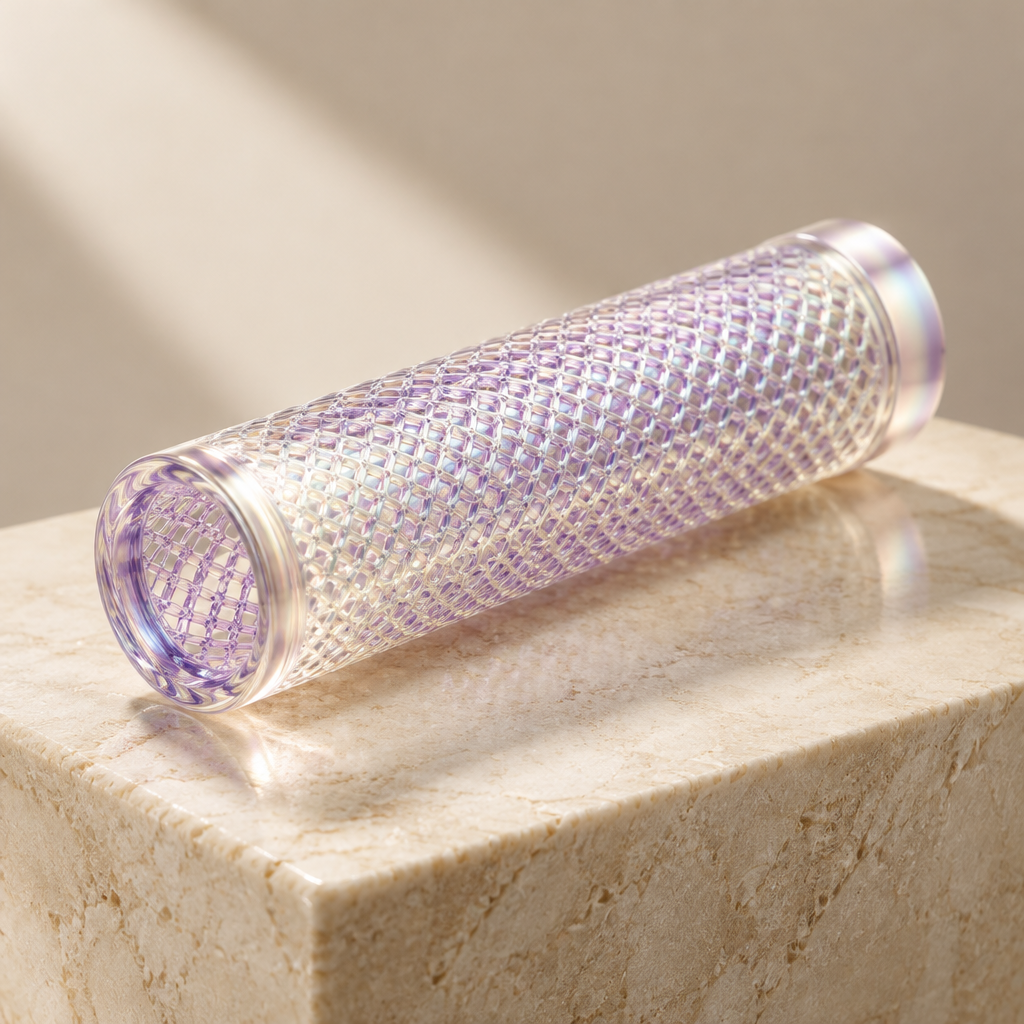
Microtubule
Plant & Animal Cells
A hollow tube of tubulin — a structural track for transport and the scaffold of movement.

All Cells
The selective boundary.
The living barrier that separates the cell from the world and decides what may cross.
A note
The campaign imagery is a fictional luxury concept. Toggle to Scientific X-Ray for the labelled biological illustration.
A selectively permeable phospholipid bilayer with hydrophilic phosphate heads facing the aqueous surroundings and cytosol, and hydrophobic fatty-acid tails facing inward. Integral proteins are embedded in the bilayer, while peripheral proteins attach to its surface. Glycoproteins and glycolipids can participate in cell recognition and signalling. Cholesterol helps regulate membrane fluidity in animal-cell membranes; plant and fungal membranes generally contain other sterols.
Controls the entry and exit of substances by diffusion, osmosis, facilitated diffusion and active transport. Membrane proteins also act as receptors, transporters and enzymes, allowing cell signalling and communication.
All living cells, including prokaryotes and plant and animal cells.
Separates the cell from its external environment and regulates material exchange, helping maintain stable internal conditions (homeostasis).
The hydrophobic interior of the membrane confines ions and many polar substances; specific transport proteins control routes across the membrane.
Plant & Animal Cells
A hollow tube of tubulin — a structural track for transport and the scaffold of movement.

Plant & Animal Cells
A dynamic lattice of filaments that shapes the cell, moves its contents and pulls it apart.

Specialized Animal Cells
Short rhythmic projections that sweep fluid across a cell surface or sense the world.