
Free Ribosome
All Cells (80S eukaryotic; 70S prokaryotic)
A floating particle of RNA and protein that reads genetic messages and assembles the cell's proteins.
Plant & Animal Cells
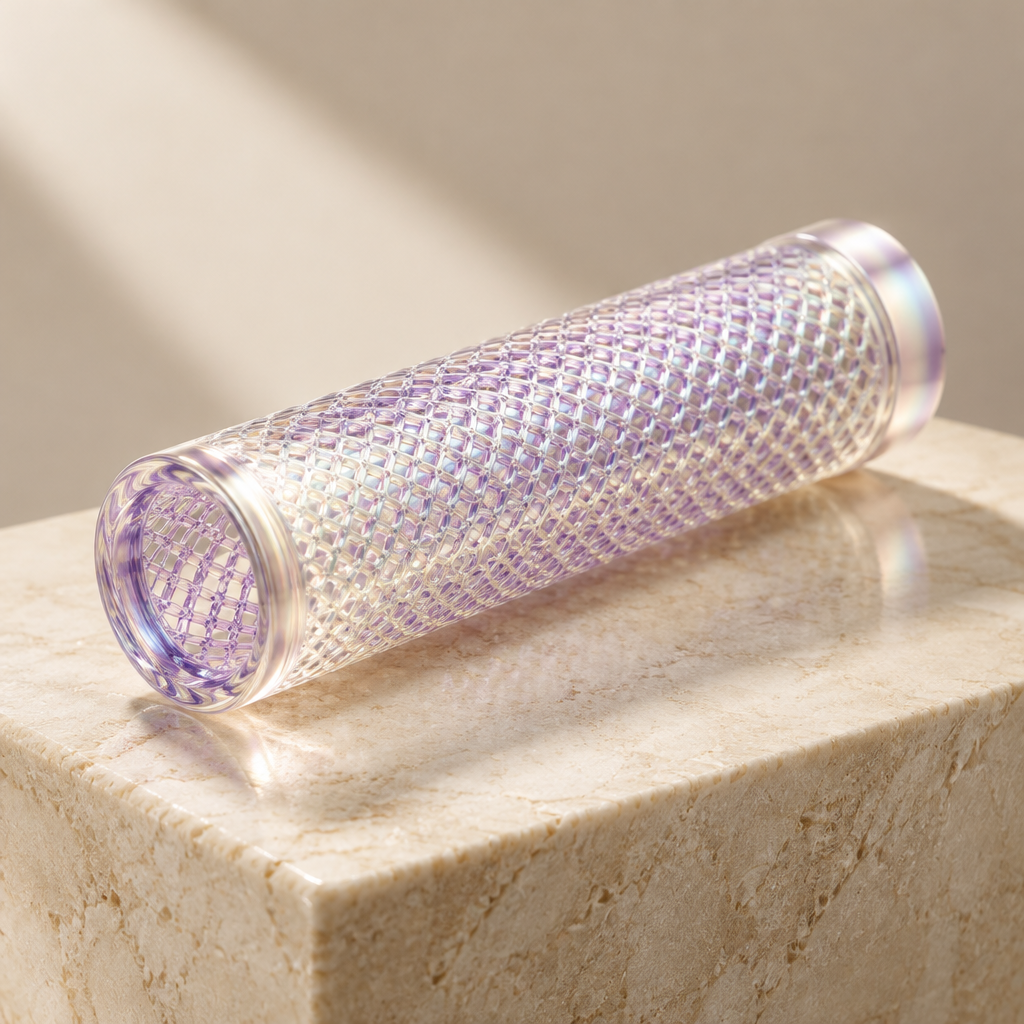
The lattice of motion.
A hollow tube of tubulin — a structural track for transport and the scaffold of movement.
A note
The campaign imagery is a fictional luxury concept. Toggle to Scientific X-Ray for the labelled biological illustration.
Hollow, cylindrical structures composed of tubulin proteins (α-tubulin and β-tubulin). Each microtubule consists of 13 protofilaments arranged into a hollow tube. Part of the cytoskeleton and can rapidly assemble and disassemble according to cellular requirements. Not membrane-bound.
Maintains cell shape and provides mechanical support. Acts as tracks for motor proteins (kinesin and dynein) to transport vesicles and organelles within the cell. Forms spindle fibres during cell division, enabling chromosome movement and separation. Forms the structural framework of eukaryotic cilia and flagella, allowing cellular movement.
Plant and animal cells and other eukaryotes. Prokaryotes lack typical eukaryotic microtubules, although some possess related tubulin-like proteins.
Maintains cellular organisation and enables intracellular transport. Essential for chromosome segregation during cell division and contributes to cell movement through cilia and flagella.
Motor proteins move cargo along microtubules and controlled growth and shortening help move chromosomes.
All Cells (80S eukaryotic; 70S prokaryotic)
A floating particle of RNA and protein that reads genetic messages and assembles the cell's proteins.

Animal Cells (absent in most higher plants)
A precise cylinder of microtubule triplets — the organiser of the cell's internal geometry.

Plant & Animal Cells
A dynamic lattice of filaments that shapes the cell, moves its contents and pulls it apart.