
Centriole
Animal Cells (absent in most higher plants)
A precise cylinder of microtubule triplets — the organiser of the cell's internal geometry.

Specialized Animal Cells
Rhythm at the surface.
Short rhythmic projections that sweep fluid across a cell surface or sense the world.
A note
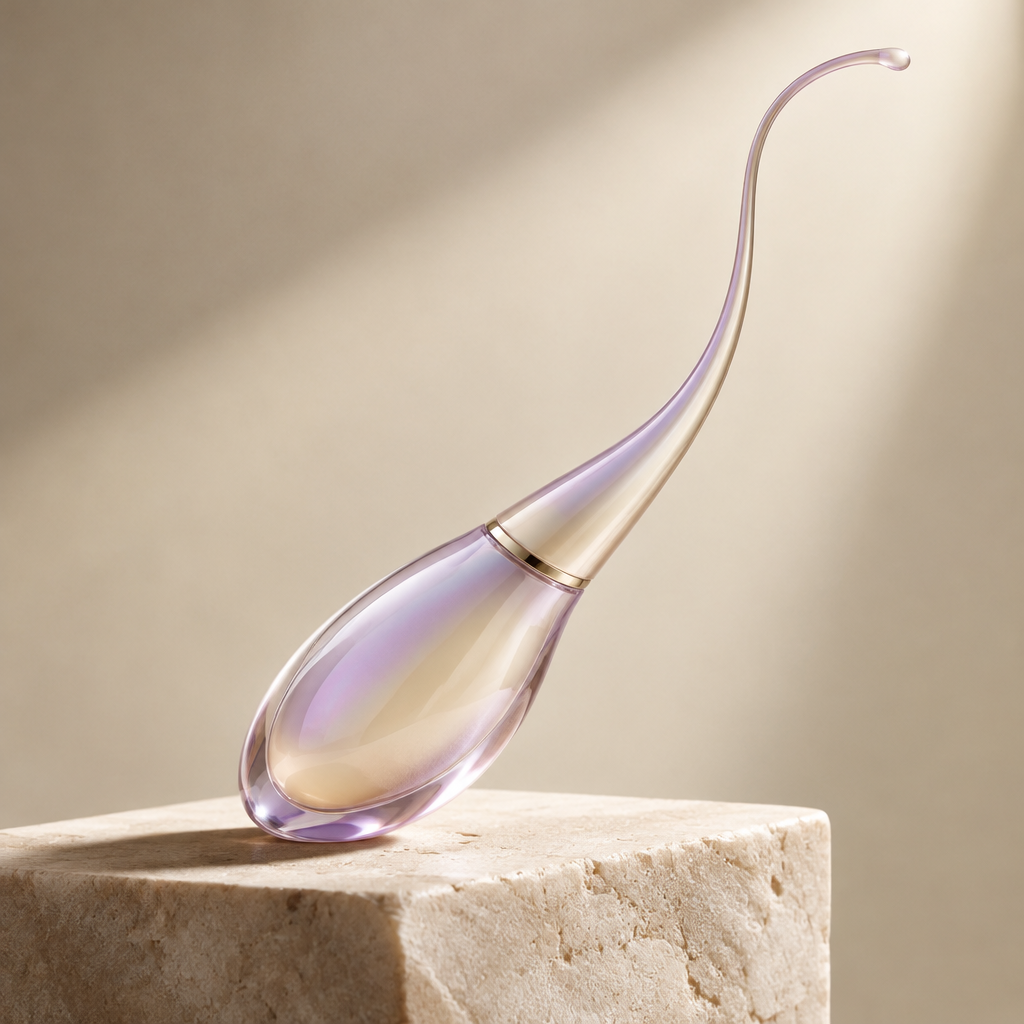
The campaign imagery is a fictional luxury concept. Toggle to Scientific X-Ray for the labelled biological illustration.
Short, hair-like projections extending from the surface of certain eukaryotic cells and surrounded by the plasma membrane. Most motile cilia contain an internal axoneme composed of nine outer microtubule doublets surrounding two central microtubules, known as the 9+2 arrangement. Dynein motor proteins generate movement through ATP-dependent interactions between adjacent microtubules. Non-motile primary cilia generally have a 9+0 arrangement.
Motile cilia generate coordinated beating movements that move fluids or particles across the cell surface or propel unicellular organisms through water. Non-motile primary cilia are involved in sensing extracellular signals.
Certain animal cells and many unicellular eukaryotes. Generally absent from typical higher plant cells.
Cilia enable specialised cells to move materials along their surfaces. For example, cilia in the respiratory tract move mucus containing trapped particles, while cilia in the oviduct help transport the egg. Primary cilia also participate in cellular signalling.
In motile cilia ATP-powered dynein slides neighbouring microtubules. Connections between them turn sliding into bending so coordinated beating is produced.
Animal Cells (absent in most higher plants)
A precise cylinder of microtubule triplets — the organiser of the cell's internal geometry.
Specialized Eukaryotic Cells
A long whip-like tail that propels a cell with a sustained undulating stroke.

All Cells
The living barrier that separates the cell from the world and decides what may cross.